Proverbs 12:4 – My Crown

Today’s Readings: Deut 13:1‐15:23, Luke 8:40‐9:6, Ps 71:1‐24, Prov 12:5‐7

Proverbs 12:4 An excellent wife is the crown of her husband,
but she who brings shame is like rottenness in his bones.

Apply #1: Rebecca is my excellent crown.

  • She is wise –Rebecca sees the world like God does.  I trust her judgment.
  • She is relaxed – Rebecca does not get over worried about situations and she helps me to rest.
  • She is gentle – Rebecca has an uncanny ability to use the least force necessary to direct those around her with grace.

    Apply #2: How do I bring shame to my spouse?  How do I need to grow as a husband?

    If you are married, I want to encourage you to focus on the beauty in your crown.  If you are not married, pray for your future crown.  Ask God how he wants to do to prepare you to bring your spouse glory and not shame.

    Deuteronomy 11:2 – Consider Discipline

    Today’s Readings: Deut 11:1‐12:32, Luke 8:22‐39, Ps 70:1‐5, Prov 12:4

    (S)cripture – Deut 11:2-5 And consider today (since I am not speaking to your children who have not known or seen it), consider the discipline of the Lord your God, his greatness, his mighty hand and his outstretched arm, 3 his signs and his deeds that he did in Egypt to Pharaoh the king of Egypt and to all his land, 4 and what he did to the army of Egypt, to their horses and to their chariots, how he made the water of the Red Sea flow over them as they pursued after you, and how the Lord has destroyed them to this day, 5 and what he did to you in the wilderness, until you came to this place…

    (O)bservation – God wants the people of Israel to remember how he disciplined the Egyptians.  He wants them to know that if they live like the Egyptians, they also will be disciplined.  In addition, he wants them to remember all that he taught them when they were in the wilderness.  As Matt Lantz taught me in Israel, “God didn’t just lead his people into the wilderness to get his people out of Egypt.  He lead his people into the wilderness to get Egypt out of his people.”

    (A)pplication – In wilderness times in my life, I want to look for what God is trying to teach me.  I want to consider his discipline and respond.

    (P)rayer – Lord, show me how you are currently disciplining me and give me the strength to respond.

    How has God disciplined you?

    Luke 8:15 – Hearing & Holding

    Today’s Readings: Deut 9:1‐10:22, Luke 8:4‐21, Ps 69:19‐36, Prov 12:2‐3

    Luke 8:15 As for that in the good soil, they are those who, hearing the word, hold it fast in an honest and good heart, and bear fruit with patience.

    The Luke readings today emphasized hearing.  “As he said these things, he called out, ‘He who has ears to hear, let him hear’” (v8), “Take care then how you hear” (v18), “My mother and my brothers are those who hear the word of God and do it” (v21).  Clearly the Sh’ma (see the March 26th post) is not just an Old Testament instruction.

    View from the mountain of prayer, Mt Arbel, of where 70% of Jesus' recorded ministry took place.

    Jesus was a very visual teacher.  On our Israel trip, I was impacted by how fertile the area of Galilee is.  However, the farmers had to pull an extraordinary amount of rocks out of their fields in order to reach good soil.  Often times you would see a two acre field lined with a half-acre piled with rocks.  It is within this context that Jesus teaches the parable of the sower and the seed.

    Apply:  Do you want your heart to be good soil?  We have to remove our rocks so we don’t just hear the Word with joy (v13), but have the word take root in our lives.  Jesus says that we have to hold the word fast with patience (also translated as perseverance).

    What are some ways that you have found enable you to hold the Word fast after hearing it?

    Deuteronomy 7:2 – No Mercy

    Today’s Readings: Deut 7:1‐8:20, Luke 7:36‐8:3, Ps 69:1‐18, Prov 12:1

    Deuteronomy 7:2 – “…and when the Lord your God gives them over to you, and you defeat them, then you must devote them to complete destruction. You shall make no covenant with them and show no mercy to them.”

    There are areas in life that God want Christians to “show no mercy” in. In the opening five verses of chapter seven, God makes it clear that his people are to destroy anything that could prompt them to worship something other than him alone. They are not to intermarry with idol worshipers. They are commanded to “break down their altars and dash in pieces their pillars and chop down their Asherim and burn their carved images with fire” (v5).

    Alter to Baal in Megiddo

    The Israelites did not obey. Over the past two weeks, Rebecca and I saw many excavated Israelite cities with pillars, carved images, and even alters to foreign Gods. Eventually God sent them into exile to correct their worship.

    Apply: There are many areas in which we allow the world to distort our worship of God alone. We let the idol of the American dream drive parts of our lives. We expose ourselves to idol worship through the media and through the desire to impress others. At times we let idol worship in by prioritizing good things like family and even ministry over God. God demands worship of him alone. Today I want to show “no mercy” to things that have the potential of affecting my worship.

    I’ve heard idol worship in a Christian’s life called Jesus and … For example, yes I want to worship God …and I want to have a nice house. What areas of your life need to be shown no mercy to protect your worship of God alone?

    Deuteronomy 6:4 – Sh’ma Israel

    Today’s Readings: Mar 26 Deut 5:1‐6:25, Luke 7:11‐35, Ps 68:19‐35, Prov 11:29‐31

    Deuteronomy 6:4-5 “Hear, O Israel: The Lord our God, the Lord is one. You shall love the Lord your God with all your heart and with all your soul and with all your might.”

    Each morning in Israel our group would quote the Sh’ma in Hebrew and English. The word Sh’ma that we translate as hear carries a lot more weight in Hebrew. It is a hearing that responds – more like a heeding.

    Notice how clear it is in the context of chapter 6. “God commanded me to teach you, that you may do them… by keeping all his statutes and his commandments… Hear therefore, O Israel, and be careful to do them… diligently keep the commandments of the Lord … Lord commanded us to do all these statutes… And it will be righteousness for us, if we are careful to do all this commandment…”

    In our western mind, it is easy to learn information and not do anything with it. For example, many of us grew up wanting to learn information from our teachers and professors, knowing that we were never going to use that information in life. However, it is not that way with God. He teaches us so that we apply what we are learning. His instructions are not something that we need to think through, decide when they are best, balk at, etc. As Nike eloquently put it… Just Do It.

    Apply: Today I want to consciously think about how I can apply God’s commandment of loving him with ALL of me.

    Deuteronomy 4:9 – Soul Keeping

    Today’s Readings: Deut 4:1‐49, Luke 6:39‐7:10, Ps 68:1‐18, Prov 11:28

    Deuteronomy 4:9 – “Only take care, and keep your soul diligently, lest you forget the things that your eyes have seen, and lest they depart from your heart all the days of your life. Make them known to your children and your children’s children—“

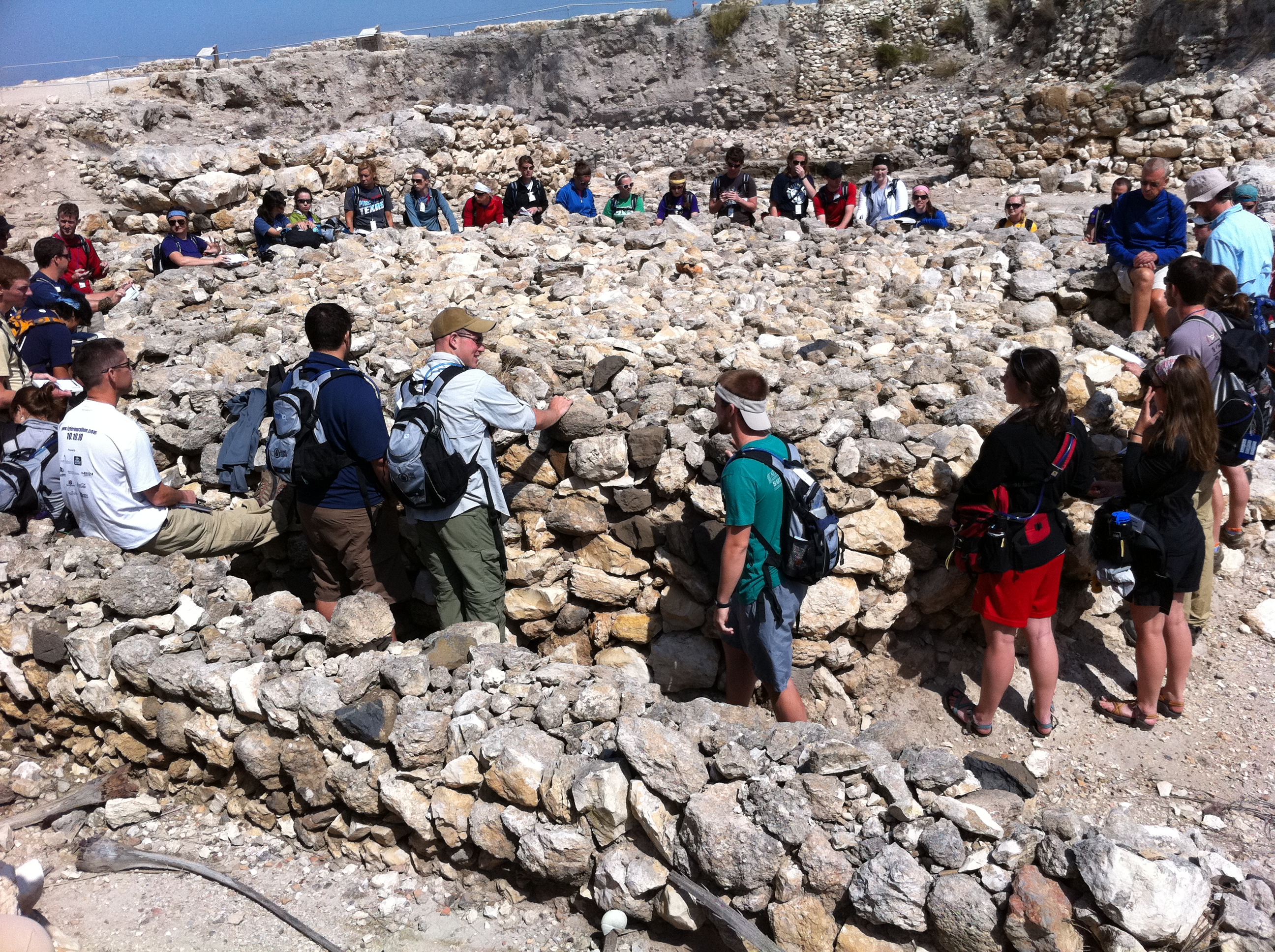
    Rebecca and I have had the privilege of spending the last two weeks in Israel. The trip has greatly impacted my view of scripture. God has given me a deeper context for the text. One of the themes on the trip was seeing the evidence of God’s people forgetting or flat out disobeying his words.

    The Pine Cove family camp director team has chosen Deuteronomy 4:9 as our theme for the summer of 2011. As I read through this verse in context today, I was reminded:
    • We have to be careful and diligent about remembering what we have seen.
    • If we are not careful/diligent to remember, the work of God will depart from our hearts all the days of our life.
    • We are to pass on what we have seen God do to our children.

    Apply: I am putting together a trip journal with pictures. I want to be careful and diligent to remember.

    What are you doing to help you to remember what your eyes have seen?

    Down Time

    I will be unable to blog the next 11 days. However, I’m still going to be doing the reading plan. I’ve listed the readings below. In invite you to interact with by responding to this post with observations on what you read.

    • Mar 13 Num 19:1‐20:29, Luke 1:1‐25, Ps 56:1‐13, Prov 11:8
    • Mar 14 Num 21:1‐22:20, Luke 1:26‐56, Ps 57:1‐11, Prov 11:9‐11
    • Mar 15 Num 22:21‐23:30, Luke 1:57‐80, Ps 58:1‐11, Prov 11:12‐13
    • Mar 16 Num 24:1‐25:18, Luke 2:1‐35, Ps 59:1‐17, Prov 11:14
    • Mar 17 Num 26:1‐51, Luke 2:36‐52, Ps 60:1‐12, Prov 11:15
    • Mar 18 Num 26:52‐28:15, Luke 3:1‐22, Ps 61:1‐8, Prov 11:16‐17
    • Mar 19 Num 28:16‐29:40, Luke 3:23‐38, Ps 62:1‐12, Prov 11:18‐19
    • Mar 20 Num 30:1‐31:54, Luke 4:1‐30, Ps 63:1‐11, Prov 11:20‐21
    • Mar 21 Num 32:1‐33:39, Luke 4:31‐5:11, Ps 64:1‐10, Prov 11:22
    • Mar 22 Num 33:40‐35:34, Luke 5:12‐28, Ps 65:1‐13, Prov 11:23
    • Mar 23 Num 36:1‐13; Deut 1:1‐46, Luke 5:29‐6:11, Ps 66:1‐20, Prov 11:24‐26
    • Mar 24 Deut 2:1‐3:29, Luke 6:12‐38, Ps 67:1‐7, Prov 11:27

    Numbers 16:44-46 – Congregation Intercession

    Today’s Readings: Num 16:41‐18:32, Mark 16:1‐20, Ps 55:1‐23, Prov 11:7

    Numbers 16:44-46 “…and the Lord spoke to Moses, saying, 45 ‘Get away from the midst of this congregation, that I may consume them in a moment.’ And they fell on their faces. 46 And Moses said to Aaron, ‘Take your censer, and put fire on it from off the altar and lay incense on it and carry it quickly to the congregation and make atonement for them…’”

    Observations:
    • God tells Moses that he will “consume” the congregation.
    • Moses and Aaron fell on their faces before God.
    • Moses tells Aaron to quickly make atonement for them – intercede on their behalf.

    Reading through the Torah the last few months, Moses’ intercession for the people he is leading has been a reoccurring theme. Moses sees the anger of God kindled by the Israelite’s sin. God tells him that he is going to punish them. Moses prays for the people. Some and sometimes all of the Israelites are spared, seemingly through his prayers.

    Our western mind focuses on the individual. The corporate nature of much of the Old and New Testament cannot be avoided. Within this context, God’s ordained leaders are often responsible for corporate obedience and blessing of the people they lead.

    Application:
    Today, I will intercede with God for the resident and summer staff I lead at camp, the families I am assigned as a deacon in church, and the family God has given me to lead and love.

    Are you interceding with God for the lives of the people you lead?

    Proverbs 11:6 – Righteousness Delivers

    Today’s Readings: Num 15:17‐16:40, Mark 15:1‐47, Ps 54:1‐7, Prov 11:5‐6

    Proverbs 11:6 The righteousness of the upright delivers them,
    but the treacherous are taken captive by their lust.

    Observations:
    • Righteousness delivers
    • Lust takes people captive

    We know that the gospel shows us that we cannot live apart from sin. We also know that Jesus has ultimately delivered us where our unrighteousness could not. With that in mind, the principle expressed in the Proverb is exciting. If we live righteously we are delivered from many of life’s traps. If we are not careful we can be taken captive by lust.

    Apply:
    We cannot let the desire for things of the flesh take over our drive to live righteously before God.

    Prayer:
    Lord, show me areas of my life that have been taken captive. Give me the strength to live righteously and deliver myself from the traps that are set for me.

    What steps are you currently taking to deliver yourself?

    Mark 14:72 – Broke Down

    Today’s Readings: Num 14:1‐15:16, Mark 14:53‐72, Ps 53:1‐6, Prov 11:4

    Mark 14:72 And immediately the rooster crowed a second time. And Peter remembered how Jesus had said to him, “Before the rooster crows twice, you will deny me three times.” And he broke down and wept.

    Observations:
    • Peter remembered Jesus’ words.
    • His sin here was literally denying Jesus… In many ways, that is what all sin is.
    • The conviction of his sin broke him down emotionally.
    • Peter wept.

    Do we let our sin affect us in this way? 2 Cor 7:10 says “…Godly grief produces a repentance that leads to salvation without regret…” If we truly agree with God in relation to our sin, we would be broken. In Nehemiah 1, Nehemiah hears that the walls of Jerusalem are broken down and he “…sat down and wept and mourned for days” (Neh 1:4).

    Apply: Often I move immediately from seeing my sin to trying to fix it. Today, I want my sin to break me down and produce a godly grief that leads to repentance.

    What produces Godly grief in your life?